By June Calloway, EditorLast updated: August 20, 2026
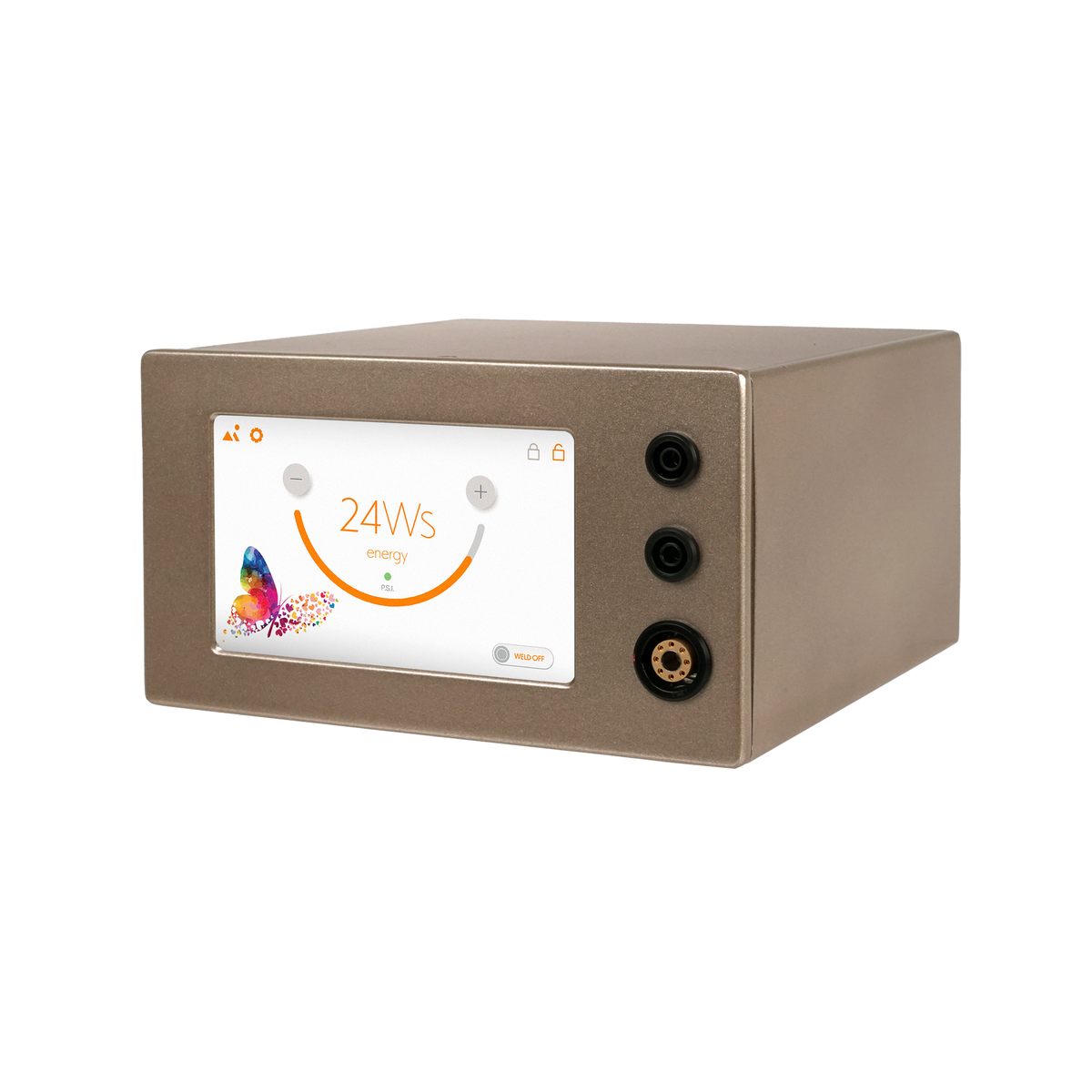
The decision most Sunstone buyers face is not which brand but which tier. The Zapp is a 3–10 joule entry machine for $1,249: the right tool if gold-filled and fine chain are your business. The Orion mPulse is a 1–30 joule studio flagship from $3,199: the deliberate choice for platinum, heavy-gauge sterling, mixed-metal menus, and operators who already have the volume to justify it. Both prices live-verified on Sunstone’s product pages in August 2026.
For most first-season operators, the Zapp is the honest starting point and the mPulse is deliberate overkill until volume and metals make the case. Here is where that line sits.
Side by side
| Welder | Energy range | Interface | Metal range | Warranty | Price (Aug 2026) |
|---|---|---|---|---|---|
| Sunstone ZappEntry | 3–10 J (1 J steps) | Dial | Gold-filled, fine chain | 3-year | $1,249 |
| Sunstone Orion mPulseFlagship | 1–30 J (0.5 J steps 1–15 J) | Touchscreen + Tru-Fire | Full range incl. platinum | 3-year (Circle optional) | from $3,199 |
Specs from Sunstone product pages, live-verified August 2026. Prices drift; confirm on the linked pages before you buy.
The joule tier: why metal decides the machine
Different metals fuse at different energies, so the chain you plan to sell determines the welder you need. Based on operator reports and Sunstone’s own guidance:
- Gold-filled and fine chain: 3–15 joules. The Zapp’s 3–10 joule ceiling sits in the middle of this band, which is exactly where most first-season menus live.
- Sterling silver: roughly 10–25 joules. The Zapp grazes the bottom of this range at 10 joules. Heavier sterling links push past it; the Zapp Plus 2 and mPulse cover it fully.
- Platinum and heavy gauge: 30 joules and up. This is the mPulse’s territory. It reaches the full 1–30 joule range with 0.5-joule fine steps between 1 and 15 joules for precision across gauges.
If your metal menu is gold-filled only, the Zapp’s ceiling is not a constraint you will hit. If you plan to offer sterling, mixed metals, or heavier links, the ceiling is real, and sizing up now costs less than buying twice.
The scale question: when volume justifies the mPulse
Owner Olivia adding permanent jewelry to an existing salon is the operator the mPulse is designed for. She already has foot traffic and group bookings; her break-even on a $3,199 machine is faster than it would be for a first-time pop-up operator, because the appointments are already coming. The touchscreen and Tru-Fire Technology reduce time between customers; the fine 0.5-joule steps keep welds consistent when she is switching between metal types across a full day of walk-ins.
For an operator on a first-season schedule of weekend markets and bachelorette parties, that interface premium is real capital with a longer payback. The Zapp’s dial is simpler to learn, and at $60–90 profit per bracelet, a $1,249 machine is a shorter break-even at lower volume. The question to answer honestly: what does my metal menu look like, and do I already have the volume to justify the difference?
The buying-twice math
Operators commonly report outgrowing the Zapp when they add heavier sterling or a high-volume booking calendar. If that growth is likely in the first year, the Zapp and then the mPulse is a more expensive path than starting with the mPulse. At $1,249 + $3,199, the sequential path costs $4,448 before the used-Zapp resale. The mPulse alone is $3,199.
The Zapp is still the right first machine if: gold-filled is the plan, the business model is unproven, and capital preservation matters. But “I’ll upgrade later” is worth pricing out before you commit.
The middle path: Zapp Plus 2
Before the verdict: the Zapp Plus 2 (from $1,699) is worth naming here. It reaches the same full 1–30 joule range as the mPulse via a lock-in digital dial, covers all standard metals including heavier sterling, and is the lightest Sunstone at 1.9 lbs. If you want the mPulse’s metal range without the touchscreen price, the Zapp Plus 2 is the value answer. The mPulse earns its premium over the Plus 2 through the 0.5-joule fine steps below 15 joules, the touchscreen interface, and the Tru-Fire system, features that matter most at sustained high volume across multiple metals in a single day.
The verdict
Buy the Zapp if your first season is gold-filled and fine chain, you want name-brand support at the lowest Sunstone price, and your metal menu is not growing past fine sterling in the near term. The 3–10 joule range does that job, and the $1,249 entry point has a fast break-even at weekend-market volume.
Buy the Orion mPulse if you weld platinum or heavy-gauge sterling, you already have salon foot traffic or confirmed group-event bookings, you want the touchscreen speed and fine joule control for a full day of mixed metals, or the buying-twice math puts you here anyway.
Either way, put the price against your own booking rate before you spend. Operators who price correctly report $60–90 profit per bracelet after chain and clasp cost; both machines are a countable number of events, not a leap of faith.
Run either price against your own event rate and metal mix. The profit calculator turns your numbers into a break-even count, in bracelets and bookings.
Calculate your break-even →Zapp vs Orion mPulse FAQ
What is the main difference between the Zapp and the Orion mPulse?
The Zapp delivers 3–10 joules on a dial for $1,249: the right range for gold-filled and fine chain. The Orion mPulse covers 1–30 joules with 0.5-joule fine steps below 15 joules, a touchscreen, and Tru-Fire Technology, from $3,199. The gap is metals and interface, not just price: the mPulse reaches platinum and heavy gauge; the Zapp does not.
Is the Orion mPulse worth $1,950 more than the Zapp?
For an operator who already has salon foot traffic or event volume across mixed metals, usually yes. At $60–90 profit per bracelet, the mPulse price premium pays back in a countable number of appointments, and you avoid the cost of buying again when volume or metals outgrow the Zapp. For a first-season operator welding mostly gold-filled, the Zapp is more likely to pay back first.
Where does the Zapp Plus 2 fit between them?
The Zapp Plus 2 (from $1,699) is the middle answer worth naming: it reaches the full 1–30 joule range on a digital lock-in dial, covers all standard metals including heavier sterling, and is the lightest Sunstone at 1.9 lbs. If you want the mPulse range without the touchscreen premium, the Zapp Plus 2 is the value pick.
Do both machines carry the same warranty and support?
Yes. Both are Made in the USA, backed by a 3-year manufacturer warranty and US-based customer service. The mPulse additionally offers an optional Sunstone Circle plan that can extend coverage further. The core support that matters when a weld fails at an event is the same on both.
Can the Zapp weld sterling silver?
It can weld fine sterling at the top of its range. Operators report fine sterling starting around 10–25 joules; the Zapp tops out at 10 joules, so it sits at the very bottom of the sterling band. Thicker sterling links and mixed-gauge orders will run into that ceiling. Heavier sterling is where the Zapp Plus 2 or mPulse earns its keep.
Read the full Sunstone Zapp review and Orion mPulse review, or the other head-to-heads: Zapp vs Zapp Plus 2, Helix vs Zapp Plus 2, and Sunstone vs budget welders. New to the format? What is permanent jewelry is the place to start.