By June Calloway, EditorLast updated: August 20, 2026
Sunstone's flagship permanent-jewelry welder, the Orion mPulse, starts from $3,199 (live-checked on Sunstone's page in August 2026). It is the growth machine for operators welding platinum, heavy gauge, and a full metal menu at serious volume. Most first-season artists do not need it yet, and buying one before the business justifies it means spending $1,500–$2,000 more than necessary on a day-one welder.
That is the answer this review starts with, because the mPulse's specs are genuinely impressive and genuinely easy to over-buy. The rest of the review explains when that $3,199 becomes the smarter spend: the real joule-tier logic, what the touchscreen and Tru-Fire system buy at volume, the honest cons, and the specific “size up to this when…” triggers an operator can actually check.
Orion mPulse specifications
Per Sunstone's product page, the mPulse is the company's most advanced permanent-jewelry welder. The specs that drive the purchase decision:
- Price: from $3,199 direct from Sunstone (live-checked August 2026).
- Energy range: 1–30 joules. Fine 0.5-joule increments from 1 to 15 joules; full-joule steps from 15 to 30 joules.
- Technology: Tru-Fire Technology® pulse-arc firing, which Sunstone says reduces misfires and improves consistency across a long event.
- Interface: touchscreen for joule selection, mode, and parameter settings, plus a built-in power supply with no external adapter to manage in a tight booth.
- Warranty & support: 3-year manufacturer warranty, US-based phone support, Made in the USA. An optional Sunstone Circle plan adds a continuous warranty for a monthly fee.
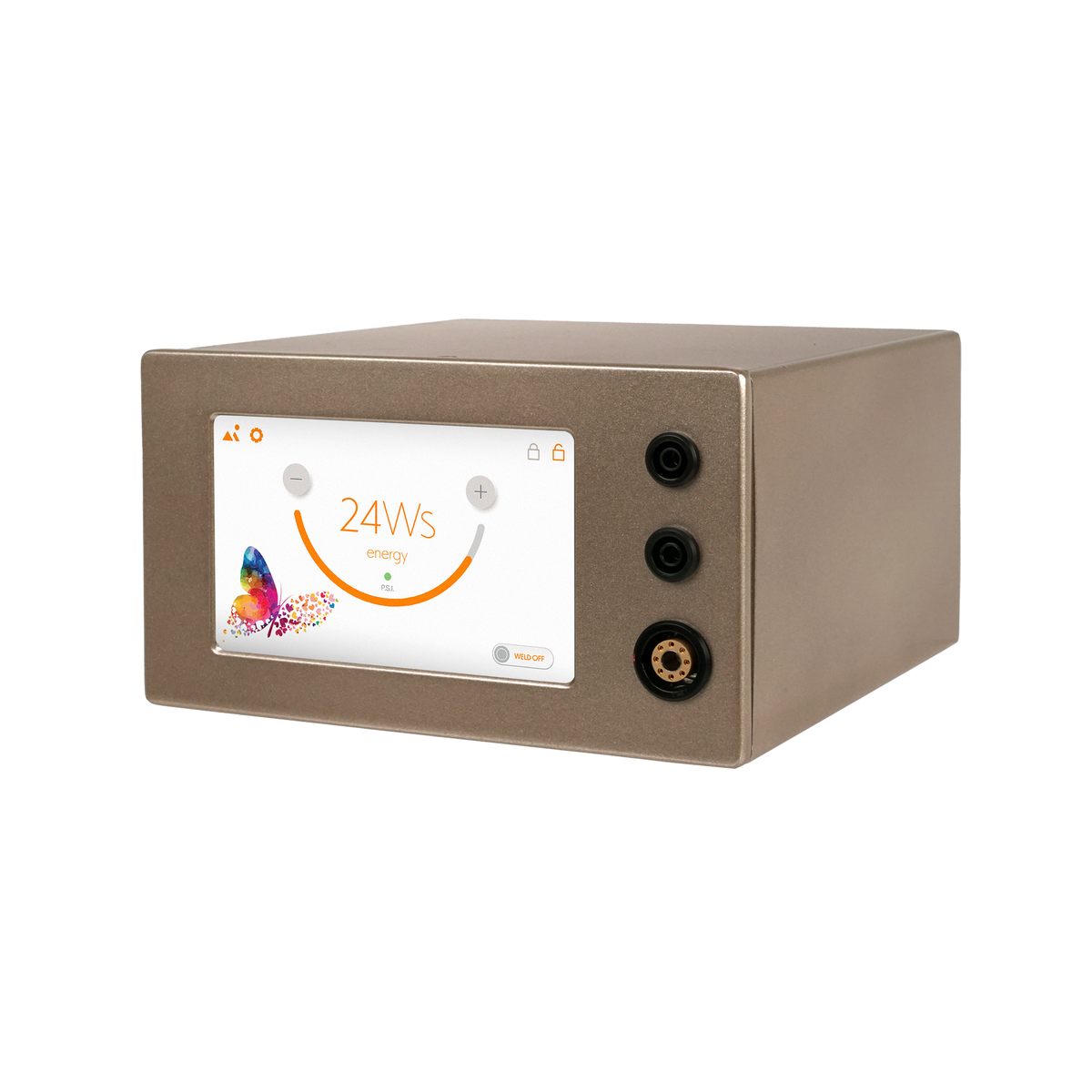
Sunstone's most advanced permanent-jewelry welder and, by the manufacturer's account, the pulse-arc machine most PJ artists choose. A touchscreen system with Tru-Fire Technology®, a 1–30 joule range and 0.5-joule increments from 1–15 joules, and a built-in power supply, built for high-volume studios and events.
- 1–30 joule range with 0.5-joule fine steps between 1–15 joules
- Touchscreen interface and Tru-Fire pulse-arc technology
- Built-in power supply; horizontal or vertical orientation for tight booths
The joule-tier logic: why 30 J+ headroom matters
Different metals fuse at different energies, and the chain you sell sets the machine you need. Operators report gold-filled and fine chain welding cleanly in the 3–15 joule band, sterling wanting 10–25 joules, and platinum or heavy-gauge links requiring 30 joules and above. The mPulse reaches all three tiers without a platform change.
That upper headroom is why the mPulse price is justified for the right operator. The Zapp tops out at 10 joules, which is enough for gold-filled and fine chain and nothing above it. A Zapp Plus 2 reaches 30 joules via a dial. At the same 30-joule ceiling, the mPulse adds 0.5-joule fine steps below 15 joules and a touchscreen that makes the transition between metals quick. If your menu stops at gold-filled, the extra range costs you money. If your menu includes sterling, platinum, or heavy gauge, the mPulse handles the whole card.
The fine low-end steps matter more than they first appear. Moving from a delicate gold-filled anklet to a heavier sterling bracelet requires a meaningful energy shift, and in 0.5-joule increments you can land exactly on the weld without guesswork. Over a long event welding mixed metals, that precision compounds into fewer misfires and more consistent results.
Who the mPulse is for, and who should wait
The mPulse earns its price for operators who already have volume: a salon or boutique owner adding welding to existing foot traffic, a working artist booking back-to-back events, or a seller whose booth regularly sees platinum and mixed-metal requests alongside standard gold-filled and sterling. At that scale the touchscreen's quick settings, the Tru-Fire misfire reduction, and the full 30-joule range are not luxury features. They are working-day tools that show up in throughput and repeat customer trust.
Most first-season operators should wait. If you are testing permanent jewelry at craft fairs and bachelorette parties, welding mostly gold-filled and fine sterling, the mPulse is more machine than you need and more capital than the business has proven it will return. The Zapp at $1,249 covers gold-filled and fine chain. The Zapp Plus 2 at from $1,699 adds sterling and the full 1–30 joule range. Both get you onto the Sunstone platform with real support without the full mPulse capital commitment.
Where it earns its keep
- Finest control here: 0.5 J steps below 15 J for consistent welds across metals and gauges
- Touchscreen and Tru-Fire Technology® make repeatable settings quick between customers
- Built-in power supply and compact footprint suit high-traffic events
What to watch
- Highest price of the three Sunstones, a real capital decision for a new operator
- More features than a first-week beginner will use on day one
Size up to the mPulse when…
There are four concrete triggers that shift the mPulse from “too much machine” to “the right call”:
- Mixed metals are your actual menu. If customers regularly request platinum, heavy-gauge sterling, or premium solid-gold links, the Zapp's 10-joule ceiling and the Zapp Plus 2's dial interface become real friction. The mPulse handles the whole range from one touchscreen.
- You are booking 15–20+ appointments per event. At that pace, the time saved by quick touchscreen settings and fewer misfires adds up across a six-hour pop-up. Operators report busy events producing 8–15 appointments per 4–6 hour shift; a smoother setup matters when you are near that ceiling every week.
- You have existing traffic to weld for. A salon or boutique owner already has people walking through the door. The break-even math on a $3,199 machine arrives faster on existing foot traffic than it does for a first-event operator starting from scratch.
- The “buying twice” math clears. If you are already on a Zapp or Zapp Plus 2 and routinely bumping the joule ceiling or losing time on dial adjustments, the upgrade cost from your current machine to the mPulse is often less than buying twice looked like at the start. Run the profit calculator with your real numbers before you decide.
mPulse vs Zapp Plus 2: what the premium buys
Both the mPulse and the Zapp Plus 2 reach the full 1–30 joule span. The roughly $1,500 premium over the Zapp Plus 2 (from $1,699) buys three working-day differences: the touchscreen (versus a digital dial), the Tru-Fire pulse-arc technology for reduced misfires, and the fine 0.5-joule steps below 15 joules for precision on delicate or mixed-gauge work. Same 30-joule ceiling. Same 3-year warranty. Same US manufacturing.
| Welder | Energy range | Interface | Power supply | Price (Aug 2026) |
|---|---|---|---|---|
| Orion mPulseThis review | 1–30 J (0.5 J steps 1–15) | Touchscreen | Built-in | from $3,199 |
| Sunstone Zapp Plus 2 | 1–30 J (30 settings) | Digital dial | External | from $1,699 |
| Sunstone Zapp | 3–10 J (1 J steps) | Dial | External | $1,249 |
Specs and prices from Sunstone product pages, live-checked August 2026. Prices can move; confirm on the linked pages before you buy.
The Zapp Plus 2 is the lighter, cheaper machine that covers the same metal range. At 1.9 lbs it is the most portable Sunstone, and a dial interface is perfectly workable at lower volumes. The mPulse is the studio-speed machine: the touchscreen saves meaningful time when a line is forming and the Tru-Fire system keeps that line moving. Which one is worth the price difference comes down to your event cadence and metal mix, not a preference between features.
For the full head-to-head, the Zapp vs Orion mPulse comparison walks that decision with a complete scenario breakdown. The Sunstone lineup overview maps where each model sits. And if a non-Sunstone option interests you, the Pepetools Helix reaches 1–30 joules for around $1,499 with a dial interface and no monthly subscription on the warranty.
Honest cons
The mPulse has two real limitations worth naming before you buy. First, the price is a genuine capital decision for a new operator. At $3,199, you are spending more than twice the entry Zapp. That is the right spend when the business justifies it; it is an over-commitment when you are still testing the market. Second, it is overkill for gold-filled-only operators. If your business model is gold-filled and fine sterling chain at craft fairs and pop-ups, the touchscreen and full platinum-capable joule range are features you are paying for and not using. The Zapp Plus 2 or the entry Zapp deliver the metal range that business actually needs for meaningfully less.
The verdict, and the math to run first
The Orion mPulse is the machine to buy when your permanent-jewelry business is real, volume is consistent, and your metal menu runs the full range from gold-filled to platinum. The touchscreen, Tru-Fire Technology, and fine low-end joule control are working-day advantages at that scale, and the 3-year warranty plus US phone support back them up when something goes wrong at an event.
It is not the machine to start on. Permanent jewelry is a proven, matured business with roughly 242,000 US searches a month, up about 8% year over year. Local markets are rarely saturated. Operators commonly report $60–90 of profit per welded bracelet after materials. Even the $3,199 mPulse breaks down to a countable number of events, not a leap of faith. But so does a less expensive machine that the business your first season actually calls for. Run your own numbers in the calculator before committing to the top tier.
Put your booking rate, your metal mix, and the $3,199 mPulse price against your own break-even: the profit calculator turns those numbers into a bracelet count and an event count, so the decision is math, not a guess.
Test the mPulse against your numbers →Orion mPulse FAQ
How much does the Orion mPulse cost?
Sunstone lists the Orion mPulse from $3,199, live-checked on the manufacturer page in August 2026. Color and stylus variants run a little higher. That price sits above the Zapp Plus 2 (from $1,699) and the entry Zapp ($1,249). Prices can move; confirm the current figure on the linked product page before you buy.
What is the joule range on the Orion mPulse?
Per Sunstone's product page, the mPulse covers 1–30 joules: fine 0.5-joule steps from 1 to 15 joules, then full-joule steps from 15 to 30. That low-end fine control is the signature feature — it lets you lock in a consistent weld for delicate gold-filled chain and step up to platinum-capable energy without swapping machines.
What metals does the Orion mPulse weld?
It covers the full standard range. Operators report gold-filled welding cleanly in the 3–15 joule band, sterling in the 10–25 joule range, and platinum and heavy-gauge chain at 30 joules and above. All three tiers are reachable from a single touchscreen interface without swapping machines.
Is the Orion mPulse worth it over the Zapp Plus 2?
Both reach the full 1–30 joule span, so the premium buys three things: the touchscreen, Tru-Fire Technology (fewer misfires), and the finer 0.5-joule steps below 15 joules for delicate or mixed-gauge work. For a salon, back-to-back events, or a booth that sees platinum requests alongside gold-filled, those are real working-day differences. For gold-filled and sterling at weekend pop-ups, a Zapp Plus 2 delivers the same joule range for roughly $1,500 less.
What is Tru-Fire Technology?
Tru-Fire Technology is Sunstone's pulse-arc firing system on the mPulse, which the manufacturer says reduces misfires and improves weld consistency. At a busy event where a misfire means restarting a customer's chain, fewer misfires translate directly into smoother throughput and fewer wasted attempts.
See the full machine lineup in the best permanent jewelry welders roundup. Read the Sunstone Zapp review for the entry option, the Helix review for the non-Sunstone alternative, or compare the two flagship Sunstones side by side in the Zapp vs Orion mPulse comparison.